Constellation · Men
Mensa
The Table Mountain
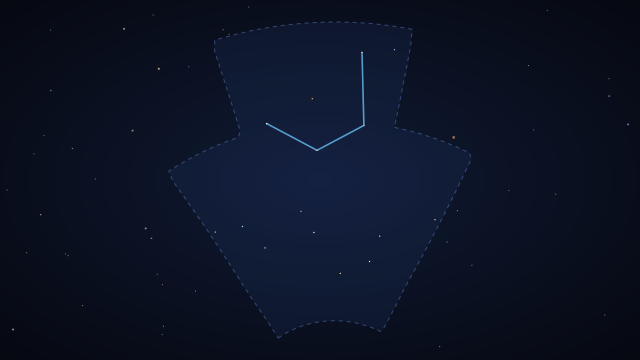
The only constellation named after a geographic feature on Earth, Table Mountain in South Africa. It contains part of the Large Magellanic Cloud.
Magnitude 5.08
Highest in the sky at 9 pm local time (winter in the northern hemisphere)
Latitudes where every part of it rises above the horizon at some time of year
The whole sky covers about 41,253 square degrees
Stars brighter than about magnitude 6, the naked-eye limit under dark skies
Can you see Mensa from where you live?
This depends only on your latitude. Pick the row nearest to you; for your exact sky tonight, use the sky map.
| Latitude | Mensa |
|---|---|
| 60°N | Never rises |
| 40°N | Never rises |
| 20°N | Only part of it ever clears the horizon |
| the equator | The whole constellation rises and sets |
| 20°S | The whole constellation rises and sets |
| 40°S | Visible all night, all year (it never sets) |
| 60°S | Visible all night, all year (it never sets) |
Questions about Mensa
When is Mensa best seen?
Mensa stands highest in the sky at 9 pm local time in January. That makes winter evenings the best time for observers in the northern hemisphere; in the southern hemisphere the season is reversed.
What is the brightest star in Mensa?
The brightest star in Mensa is Alpha Mensae, magnitude 5.08.
Where on Earth can you see Mensa?
The whole of Mensa can be seen from latitudes between about 90°S and 5°N. From 40°N: Never rises. From 35°S: Visible all night, all year (it never sets).
What does Mensa mean?
Mensa is Latin for "the Table Mountain". Introduced by Nicolas-Louis de Lacaille in the 1750s.