Sky Briefing • Wednesday, October 28, 2026
Geomagnetic levels peak below storm thresholds as major earthquakes strike
Geomagnetic activity remained below storm levels this week, while the Sun launched multiple coronal mass ejections away from Earth and strong seismic events struck globally.
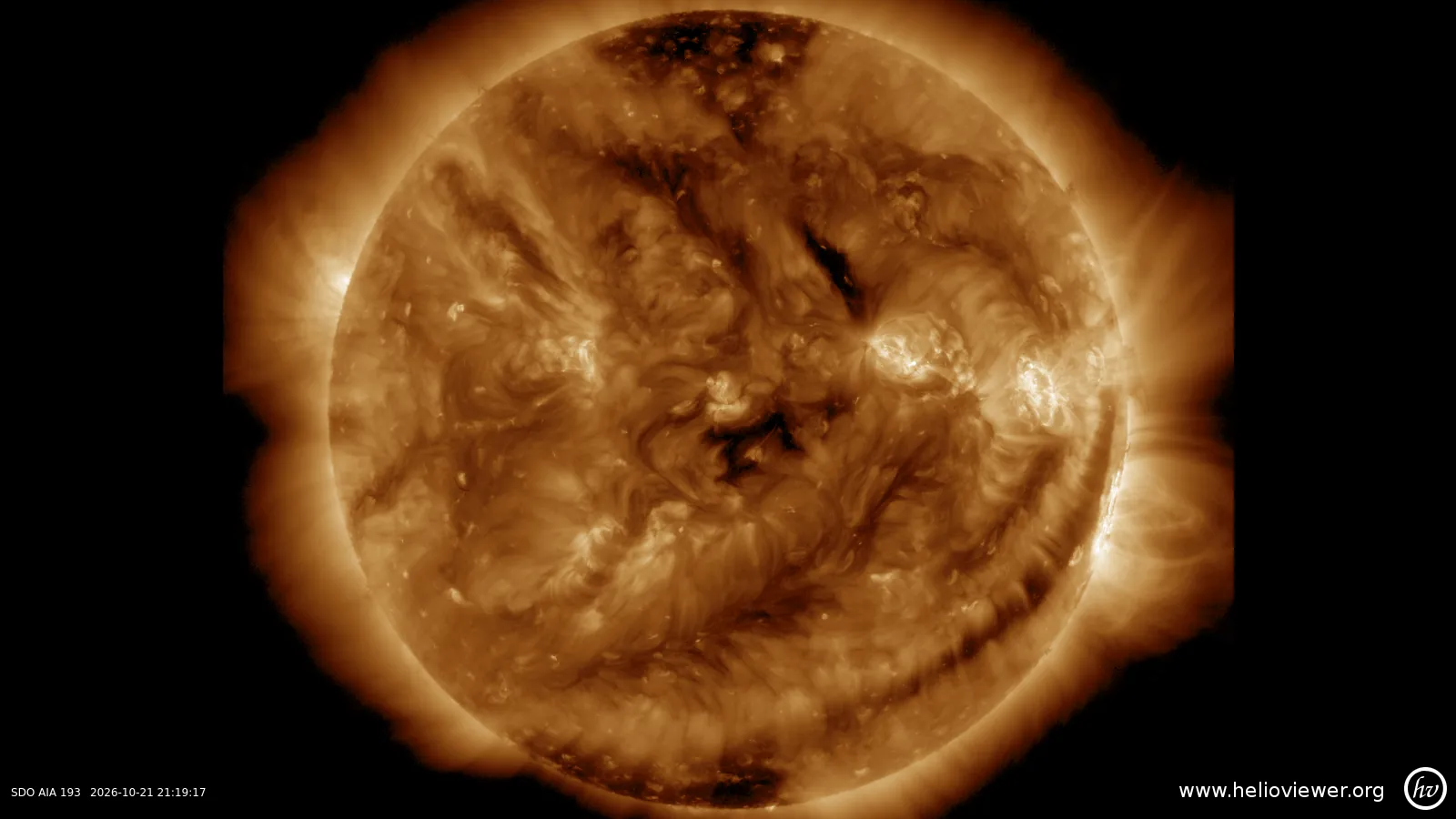
AIA 193 Å (corona and coronal holes), Oct 21, 2026, 21:19 UTC. The Sun at the time of the week's strongest flare (C1.4), a modest event. Credit: NASA/SDO (AIA), rendered by Helioviewer.org. Real observation, not an illustration.
By SpaceWeatherTracker Staff • Data: NOAA SWPC, USGS, NOAA GOES, NASA DONKI, SpaceWeatherTracker meteor calendar •
2 min read
Peak Kp index
4.7
Below storm threshold (Kp 5)
Strongest flare
C1.4
GOES X-ray class
CMEs catalogued
26
None Earth-directed
Largest earthquake
M7.0
USGS
Solar activity remained muted over the past seven days, keeping severe space weather at bay across the globe. Earth's geomagnetic field experienced mild disturbances that peaked below official storm thresholds, confining auroral displays to polar regions. Meanwhile, instruments tracked significant seismic energy across three major tectonic zones on Earth.
In interplanetary space, dozens of solar eruptions occurred without posing hazards to satellite networks or power grids on the ground. Observers can also prepare for the upcoming Leonids meteor shower scheduled to peak in mid-November. The following review covers the vital geophysical and astronomical measurements collected across the week.
Lead story · Space weather
Space weather
Geomagnetic Conditions
Geomagnetic activity peaked at Kp 4.7 this week, falling short of official geomagnetic storm levels. Because the disturbances remained mild, associated auroral displays stayed mainly at high latitudes and caused minimal disruption to satellite operations or navigation networks. NOAA issued warnings and alerts for an unsettled geomagnetic K-index of 4 on October 21 and October 23, with thresholds reached at 2059 UTC and 1953 UTC, respectively.
The record
- Geomagnetic activity peaked at Kp 4.7 this week
- That is below storm level, so aurora stayed mainly at high latitudes.
- NOAA SWPCOct 21, 2026, 9:00 PM UTC
- NOAA alert: Geomagnetic K-index of 4
- Threshold Reached: 2026 Oct 23 1953 UTC.
- NOAA SWPC alertsOct 23, 2026, 7:55 PM UTC
- NOAA warning: Geomagnetic K-index of 4 expected
- Valid From: 2026 Oct 23 1926 UTC.
- NOAA SWPC alertsOct 23, 2026, 7:27 PM UTC
The Sun
Solar Activity
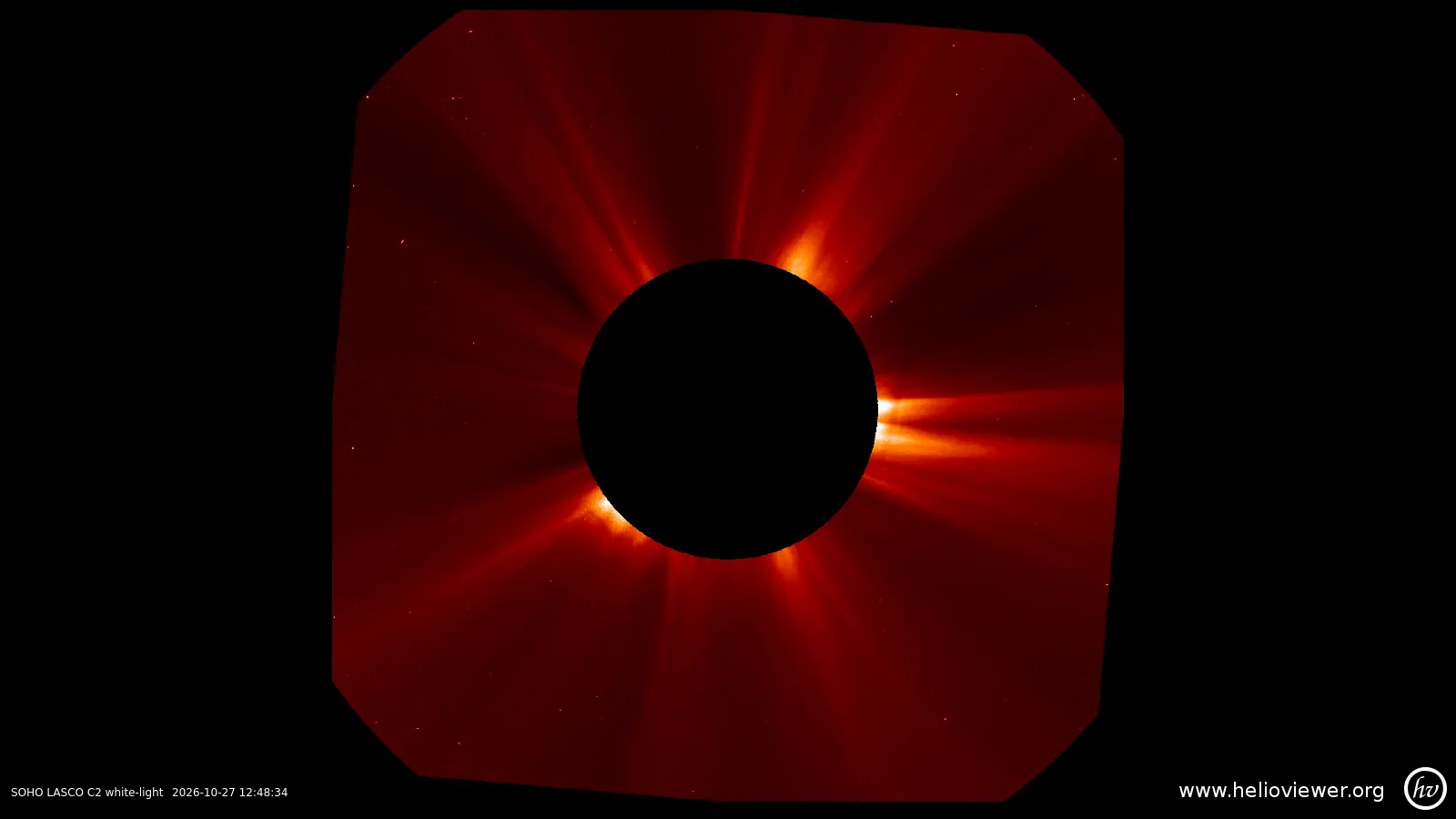
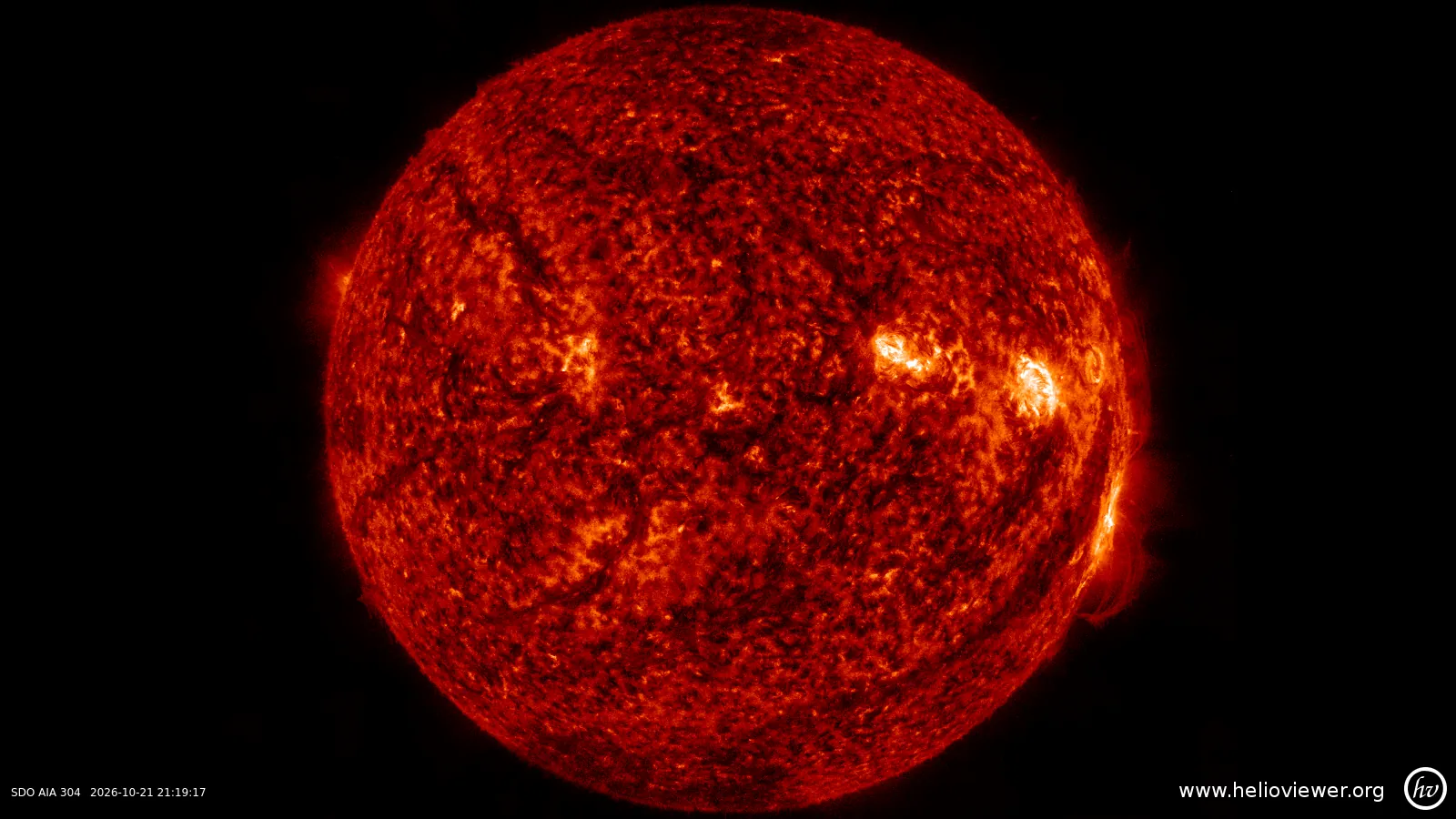
Solar flaring stayed low over the past seven days, during which GOES recorded 62 flares. The strongest flare of the week was a modest C1.4 event on October 21, which lacked the intensity to cause significant high-frequency radio blackouts. In addition, 26 coronal mass ejections were catalogued this week with none Earth-directed, although the fastest was measured near 973 km/s.
The record
- The strongest flare of the week was C1.4
- 62 flares were recorded by GOES over the past seven days.
- NOAA GOES X-ray fluxOct 21, 2026, 9:19 PM UTC
- 26 coronal mass ejections were catalogued this week, none Earth-directed
- The fastest was measured near 973 km/s.
- NASA DONKIOct 27, 2026, 12:53 PM UTC
Earth
Seismic Activity
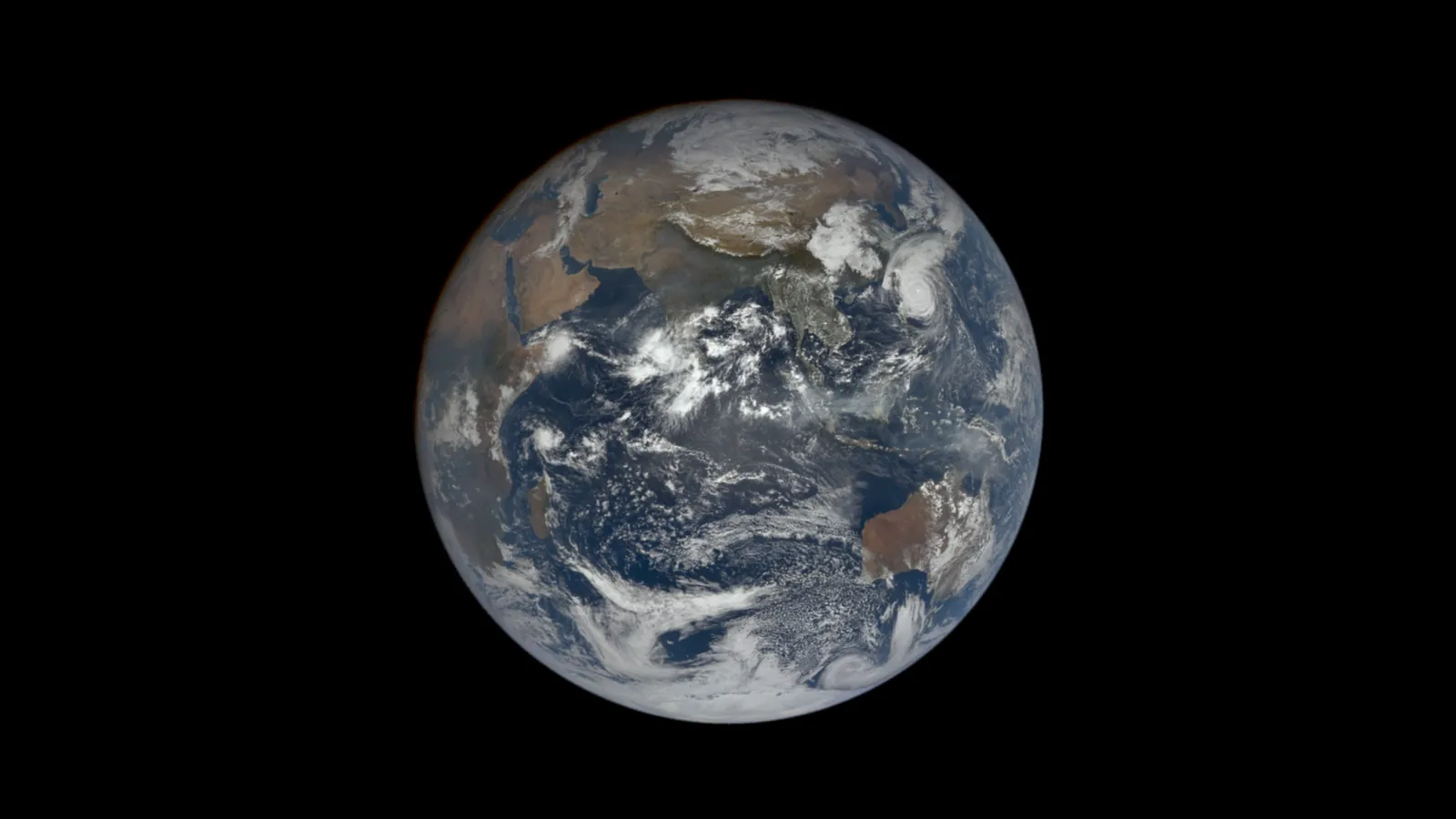
Seismometers registered three powerful earthquakes around the globe over the week. A magnitude 7.0 earthquake occurred on October 22 located 191 km ENE of Nagqu, China. Subsequent seismic events included a magnitude 6.9 earthquake on October 24 located 197 km WNW of Port-Olry, Vanuatu, followed by a magnitude 6.5 earthquake in the Bonin Islands, Japan region on October 25.
Outlook
The Week Ahead in the Sky
Looking ahead to mid-November, the Leonids meteor shower peaks on the night of Tuesday, November 17. Skywatchers can expect up to 15 meteors per hour under ideal dark skies, with meteors radiating from Leo. The shower is best viewed after midnight until dawn on November 17, when Leo has risen well above the horizon.
The record
- Leonids meteor shower peaks on the night of Tuesday, November 17
- Up to 15 meteors per hour under ideal dark skies, radiating from Leo. Best viewed after midnight until dawn on November 17, when Leo has risen well above the horizon.
- SpaceWeatherTracker meteor calendarNov 17, 2026, 12:00 PM UTC
Sources and methodology
This briefing is compiled from official agency data for the seven days ending on the issue date. Figures are reproduced as published; times are UTC. Nothing in this issue is estimated or modelled by us unless stated.
- NOAA SWPC alerts2 records · retrieved Oct 28, 2026, 1:00 PM UTC
- USGS1 record · retrieved Oct 28, 2026, 1:00 PM UTC
- USGS1 record · retrieved Oct 28, 2026, 1:00 PM UTC
- NOAA SWPC1 record · retrieved Oct 28, 2026, 1:00 PM UTC
- USGS1 record · retrieved Oct 28, 2026, 1:00 PM UTC
- NOAA GOES X-ray flux1 record · retrieved Oct 28, 2026, 1:00 PM UTC
- NASA DONKI1 record · retrieved Oct 28, 2026, 1:00 PM UTC
- SpaceWeatherTracker meteor calendar1 record · retrieved Oct 28, 2026, 1:00 PM UTC
Image credits
Every picture in this issue is a real observation from a NASA, ESA or NOAA mission, taken at the time shown. None is an illustration or AI-generated image.
- Oct 21, 2026, 21:19 UTC · NASA/SDO (AIA), rendered by Helioviewer.org · NASA imagery is not copyrighted; free to use with credit (NASA media usage guidelines).
- Oct 27, 2026, 12:53 UTC · ESA & NASA/SOHO (LASCO), rendered by Helioviewer.org · SOHO is a project of international cooperation between ESA and NASA; images are free to use with credit.
- Oct 21, 2026, 21:19 UTC · NASA/SDO (AIA), rendered by Helioviewer.org · NASA imagery is not copyrighted; free to use with credit (NASA media usage guidelines).
- Oct 22, 2026, 05:32 UTC · NASA/NOAA DSCOVR EPIC · NASA imagery is not copyrighted; free to use with credit (NASA media usage guidelines).
Get the next Sky Briefing
Live NOAA solar storm alerts and the weekly night-sky forecast, free.