About Space Word Search
Space Word Search has 10 puzzles on a 12 x 12 grid, with 100 different terms from solar physics, the planets, deep space, Earth's magnetic shield, minor bodies, the Moon, spacecraft, telescopes, the night sky and the seasons. Every term is a real entry in the SpaceWeatherTracker glossary, and each word you find opens its definition with a link to the full entry. Definitions were last reviewed on 10 October 2026.
All 100 words in Space Word Search
Solar Dynamics: 10 words
- Flare: A sudden burst of radiation from the Sun's magnetic activity, ranked by peak X-ray flux as A, B, C, M or X class (X is the strongest). Glossary →
- CME: Coronal mass ejection: a huge cloud of magnetized plasma thrown out of the Sun's corona that can trigger a geomagnetic storm if it reaches Earth. Glossary →
- Corona: The Sun's hot, thin outer atmosphere, visible during a total solar eclipse and the source of the solar wind. Glossary →
- Chromosphere: The thin layer of the Sun's atmosphere between the photosphere and the corona, which glows red in hydrogen-alpha light. Glossary →
- Sunspot: A dark, cooler patch on the Sun's surface where strong magnetic fields hold back the heat rising from below. Glossary →
- Prominence: A large, bright feature that arcs out from the Sun's surface, made of dense plasma held up by magnetic fields. Glossary →
- Filament: A prominence seen against the face of the Sun, where it looks like a dark thread because it is cooler than the surface behind it. Glossary →
- Solar wind (SOLARWIND): A continuous stream of charged particles flowing out from the Sun's corona, typically at roughly 300 to 800 kilometers per second near Earth. Glossary →
- Radiation: Energy the Sun sends out as light and particles; during space weather events it includes X-rays and energetic protons that can affect satellites and radio. Glossary →
- Plasma: A gas so hot that its atoms are split into charged ions and electrons; the Sun and the solar wind are made of it. Glossary →
Planetary Worlds: 10 words
- Mercury: The smallest planet and the closest to the Sun, with almost no atmosphere; its year lasts about 88 Earth days. Glossary →
- Venus: The hottest planet, wrapped in a thick carbon dioxide atmosphere that traps heat; its surface is around 465 degrees Celsius. Glossary →
- Earth: Our home planet, the only world known to have life, protected from most of the solar wind by its magnetic field. Glossary →
- Mars: The fourth planet from the Sun, a cold desert world with a thin carbon dioxide atmosphere and the solar system's tallest volcano, Olympus Mons. Glossary →
- Jupiter: The largest planet, a gas giant with more than twice the mass of all the other planets combined and a storm called the Great Red Spot. Glossary →
- Saturn: A gas giant best known for its wide system of icy rings; it is the least dense planet, less dense than water. Glossary →
- Uranus: An ice giant whose rotation axis is tilted about 98 degrees, so it effectively spins on its side as it orbits the Sun. Glossary →
- Neptune: The farthest major planet, an ice giant with the fastest winds measured in the solar system, above 2,000 kilometers per hour. Glossary →
- Pluto: A dwarf planet in the Kuiper Belt, reclassified by the International Astronomical Union in 2006 and visited by NASA's New Horizons in 2015. Glossary →
- Exoplanet: A planet that orbits a star other than the Sun; thousands are confirmed, many found by watching a star dim as a planet crosses in front of it. Glossary →
Deep Space Secrets: 10 words
- Galaxy: A huge system of stars, gas, dust and dark matter held together by gravity; ours is the Milky Way. Glossary →
- Nebula: A cloud of gas and dust in space, where new stars can form or where a dying star has shed its outer layers. Glossary →
- Quasar: The extremely luminous core of a distant galaxy, powered by gas falling into a supermassive black hole. Glossary →
- Pulsar: A rapidly spinning neutron star that sweeps beams of radiation across space, seen from Earth as regular pulses. Glossary →
- Supernova: The explosion of a massive star at the end of its life, or of a white dwarf in some double-star systems, as bright as an entire galaxy for a short time. Glossary →
- Black hole (BLACKHOLE): A region where gravity is so strong that nothing, not even light, can escape once it crosses the event horizon. Glossary →
- Magnetar: A neutron star with an extraordinarily strong magnetic field, the source of powerful bursts of X-rays and gamma rays. Glossary →
- White dwarf (WHITEDWARF): The dense, Earth-sized core left behind when a Sun-like star runs out of fuel and sheds its outer layers. Glossary →
- Dark matter (DARKMATTER): Invisible matter known only through its gravity; it makes up most of the matter in the universe. Glossary →
- Redshift: The stretching of light to longer, redder wavelengths, seen from objects moving away and from the expansion of the universe. Glossary →
Earth's Shields: 10 words
- Ionosphere: A region of Earth's upper atmosphere, from about 60 to over 1,000 kilometers up, ionized by solar radiation; it reflects and delays radio signals. Glossary →
- Magnetopause: The boundary where Earth's magnetic field balances the pressure of the solar wind; on the Sun-facing side it usually sits about 10 Earth radii away. Glossary →
- Bow shock (BOWSHOCK): The shock wave upstream of Earth where the solar wind abruptly slows and heats as it meets the planet's magnetic field. Glossary →
- Aurora: Light produced when charged particles from space strike gases in Earth's upper atmosphere, seen near the poles as the northern and southern lights. Glossary →
- Magnetotail: The long tail of Earth's magnetic field, stretched away from the Sun by the solar wind, where energy is stored for substorms. Glossary →
- Plasmasphere: A doughnut-shaped region of cool, dense plasma around Earth, reaching out from the ionosphere along magnetic field lines. Glossary →
- Exosphere: The outermost layer of Earth's atmosphere, where the air is so thin that atoms rarely collide and slowly escape to space. Glossary →
- Ring current (RINGCURRENT): A doughnut-shaped flow of charged particles circling Earth in the inner magnetosphere, which strengthens during geomagnetic storms. Glossary →
- Substorm: A burst of energy release in Earth's magnetosphere, lasting an hour or two, that brightens the aurora and sets it in motion. Glossary →
- Polar cusp (POLARCUSP): A funnel-shaped region of Earth's magnetic field near each pole where solar wind particles can reach the upper atmosphere directly. Glossary →
Minor Space Objects: 10 words
- Asteroid: A rocky or metallic body orbiting the Sun, much smaller than a planet; most lie in the belt between Mars and Jupiter. Glossary →
- Comet: An icy body that grows a glowing coma and tail of gas and dust as it nears the Sun. Glossary →
- Fireball: A meteor brighter than magnitude -4, about as bright as the planet Venus at its best, sometimes bright enough to light up the ground. Glossary →
- Meteoroid: A small piece of rock or metal in space, from about the size of a dust grain up to about a meter across. Glossary →
- Meteorite: A piece of a meteoroid that survives the fall through the atmosphere and lands on Earth's surface. Glossary →
- Bolide: An especially bright fireball, often one that explodes in the atmosphere with a visible flash. Glossary →
- Kuiper belt (KUIPERBELT): A ring of icy bodies beyond Neptune's orbit, home to Pluto and many other dwarf planets and comets. Glossary →
- Oort cloud (OORTCLOUD): A vast, distant region of icy bodies thought to surround the solar system and supply long-period comets; it has not been observed directly. Glossary →
- Dwarf planet (DWARFPLANET): A world that orbits the Sun and is round, but has not cleared its orbit of other objects; Pluto and Ceres are examples. Glossary →
- Trojan: An asteroid that shares a planet's orbit, trapped near a stable point 60 degrees ahead of or behind it; Jupiter has thousands. Glossary →
Lunar Cycles: 10 words
- Moon: Earth's only natural satellite, whose orbit around Earth drives the monthly cycle of phases. Glossary →
- Libration: The slight rocking of the Moon as seen from Earth, which lets us view about 59 percent of its surface over time. Glossary →
- Terminator: The line between day and night on the Moon, where shadows are longest and craters look most dramatic. Glossary →
- Regolith: The layer of loose dust and broken rock covering the Moon's surface, made by billions of years of impacts. Glossary →
- Syzygy: The alignment of the Sun, Earth and Moon in a straight line, which happens at new Moon and full Moon. Glossary →
- Occultation: When one object passes in front of another, such as the Moon hiding a star or planet from view. Glossary →
- Lunar node (LUNARNODE): One of the two points where the Moon's orbit crosses the plane of Earth's orbit; eclipses happen when a new or full Moon is near a node. Glossary →
- Tidal locking (TIDALLOCKING): When an object's rotation period equals its orbital period, so it always shows the same face; the Moon is tidally locked to Earth. Glossary →
- Synodic month (SYNODICMONTH): The time from one new Moon to the next, about 29.5 days. Glossary →
- Albedo: The fraction of sunlight a surface reflects; the Moon's is low, about 12 percent, which is why it looks dark in photos from space. Glossary →
Orbital Hardware: 10 words
- Perigee: The point in an orbit around Earth where the object is closest to Earth. Glossary →
- Apogee: The point in an orbit around Earth where the object is farthest from Earth. Glossary →
- CubeSat: A small standardized satellite built from 10-centimeter cubes called units, which makes space missions cheaper. Glossary →
- Delta-v (DELTAV): The total change in velocity a spacecraft can make with its propellant, the basic measure of how far a mission can go. Glossary →
- Space debris (SPACEDEBRIS): Defunct satellites, spent rocket stages and fragments orbiting Earth that can damage working spacecraft. Glossary →
- Ion thruster (IONTHRUSTER): An engine that accelerates charged particles with electricity to produce gentle but very efficient thrust. Glossary →
- Orbital decay (ORBITALDECAY): The gradual loss of altitude of a satellite as atmospheric drag slows it down; solar storms can speed it up. Glossary →
- Launch window (LAUNCHWINDOW): The span of time during which a rocket can launch to reach its intended orbit or destination. Glossary →
- DSCOVR: A NOAA and NASA spacecraft at the Sun-Earth L1 point that measures the solar wind and gives roughly 15 to 60 minutes of warning of incoming storms. Glossary →
- GOES: NOAA's Geostationary Operational Environmental Satellites, whose X-ray sensors are used to classify solar flares. Glossary →
Astronomy Toolkit: 10 words
- Telescope: An instrument that gathers and focuses light to show faint or distant objects; a bigger aperture collects more light. Glossary →
- Aperture: The diameter of a telescope's main lens or mirror; the larger it is, the more light the telescope collects. Glossary →
- Spectroscopy: Splitting light into a spectrum to learn what an object is made of, how hot it is and how fast it moves. Glossary →
- Parallax: The apparent shift of a nearby star against distant ones as Earth orbits the Sun, used to measure distance. Glossary →
- Refractor: A telescope that uses a lens at the front to bend light into focus. Glossary →
- Reflector: A telescope that uses a curved mirror to gather and focus light; Newtonian designs are popular with amateurs. Glossary →
- Coronagraph: An instrument that blocks the Sun's bright disk to reveal the faint corona, used on spacecraft such as SOHO to spot CMEs. Glossary →
- Azimuth: The compass direction of an object along the horizon, measured in degrees from north: east is 90, south 180 and west 270. Glossary →
- Zenith: The point in the sky directly overhead, at an altitude of 90 degrees. Glossary →
- Declination: The celestial equivalent of latitude: how far north or south of the celestial equator an object lies. Glossary →
Cosmic Constellations: 10 words
- Asterism: A recognizable pattern of stars that is not one of the 88 official constellations, such as the Big Dipper. Glossary →
- Zodiac: The band of constellations along the ecliptic through which the Sun, Moon and planets appear to move. Glossary →
- Ecliptic: The apparent yearly path of the Sun across the sky, which is also the plane of Earth's orbit. Glossary →
- Circumpolar: Describes stars that never set below the horizon from a given latitude, circling the celestial pole instead. Glossary →
- Open cluster (OPENCLUSTER): A loose group of up to a few thousand young stars born together from the same cloud, such as the Pleiades. Glossary →
- Milky Way (MILKYWAY): The galaxy that contains our solar system; from Earth we see its disk as a faint band of light across the night sky. Glossary →
- Variable star (VARIABLESTAR): A star whose brightness changes over time, because of pulsation, eclipses by a companion or eruptions. Glossary →
- Cepheid: A pulsating star whose brightness cycle reveals its true luminosity, making it a key tool for measuring distances to galaxies. Glossary →
- Binary star (BINARYSTAR): Two stars bound by gravity and orbiting a common center of mass; many of the stars we see belong to such pairs. Glossary →
- Radiant: The point in the sky, within a constellation, from which the meteors of a shower appear to come; showers are named for that constellation. Glossary →
Seasonal Geometry: 10 words
- Equinox: One of two moments each year, in March and September, when the Sun is directly above the equator and day and night are nearly equal. Glossary →
- Solstice: One of two moments each year, in June and December, when the Sun reaches its most northern or southern point, giving the longest or shortest day. Glossary →
- Perihelion: The point in a planet's orbit closest to the Sun; Earth reaches it in early January. Glossary →
- Aphelion: The point in a planet's orbit farthest from the Sun; Earth reaches it in early July. Glossary →
- Axial tilt (AXIALTILT): The angle between a planet's rotation axis and its orbit; Earth's is about 23.4 degrees, which causes the seasons. Glossary →
- Eccentricity: A number from 0 to 1 describing how stretched an orbit is; 0 is a perfect circle, and Earth's orbit is nearly circular at about 0.017. Glossary →
- Inclination: The tilt of an orbit's plane compared with a reference plane, such as the ecliptic or the equator. Glossary →
- Precession: The slow wobble of Earth's rotation axis, like a spinning top, which completes one cycle in about 26,000 years. Glossary →
- Sidereal day (SIDEREALDAY): The time Earth takes to rotate once relative to the stars, about 23 hours and 56 minutes. Glossary →
- Nutation: A small nodding motion added to precession, mostly caused by the Moon's changing pull on Earth, with a period of about 18.6 years. Glossary →
Space Word Search FAQ
What is Space Word Search?
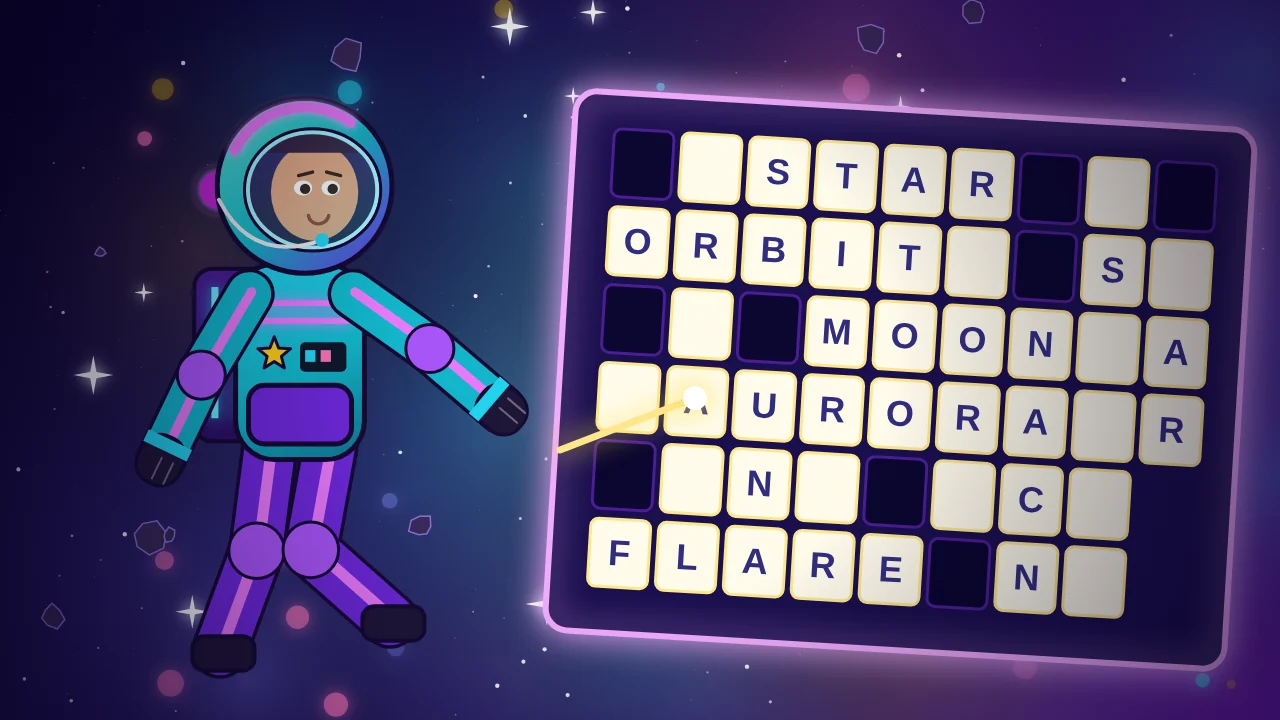
Space Word Search is a free puzzle game with 10 themed 12 x 12 grids. Each one hides 10 real astronomy and space weather terms, such as FLARE, CME, CORONA and AURORA, and every word you find opens its definition.
How many words are in the game?
100 different terms, ten in each of the 10 categories, with no term used twice. Each one is a real entry in the SpaceWeatherTracker glossary and links to it.
How do I select a word?
Drag from the first letter to the last in a straight line, or tap the first letter and then the last one. Words can be selected from either end. On a keyboard, move with the arrow keys and press Enter on the first and the last letter.
What is the difference between Relaxed and Time Attack?
Relaxed has no timer and a hint button that points to the first letter of a word. Time Attack gives you 5 minutes; finishing early adds bonus points, and your fastest time for each category is saved on your device.
Why are some long space words missing?
The grid is 12 letters wide, so terms longer than 12 letters, such as MAGNETOSPHERE and CONSTELLATION, cannot fit. Their shorter relatives, like MAGNETOPAUSE and ASTERISM, are included.